


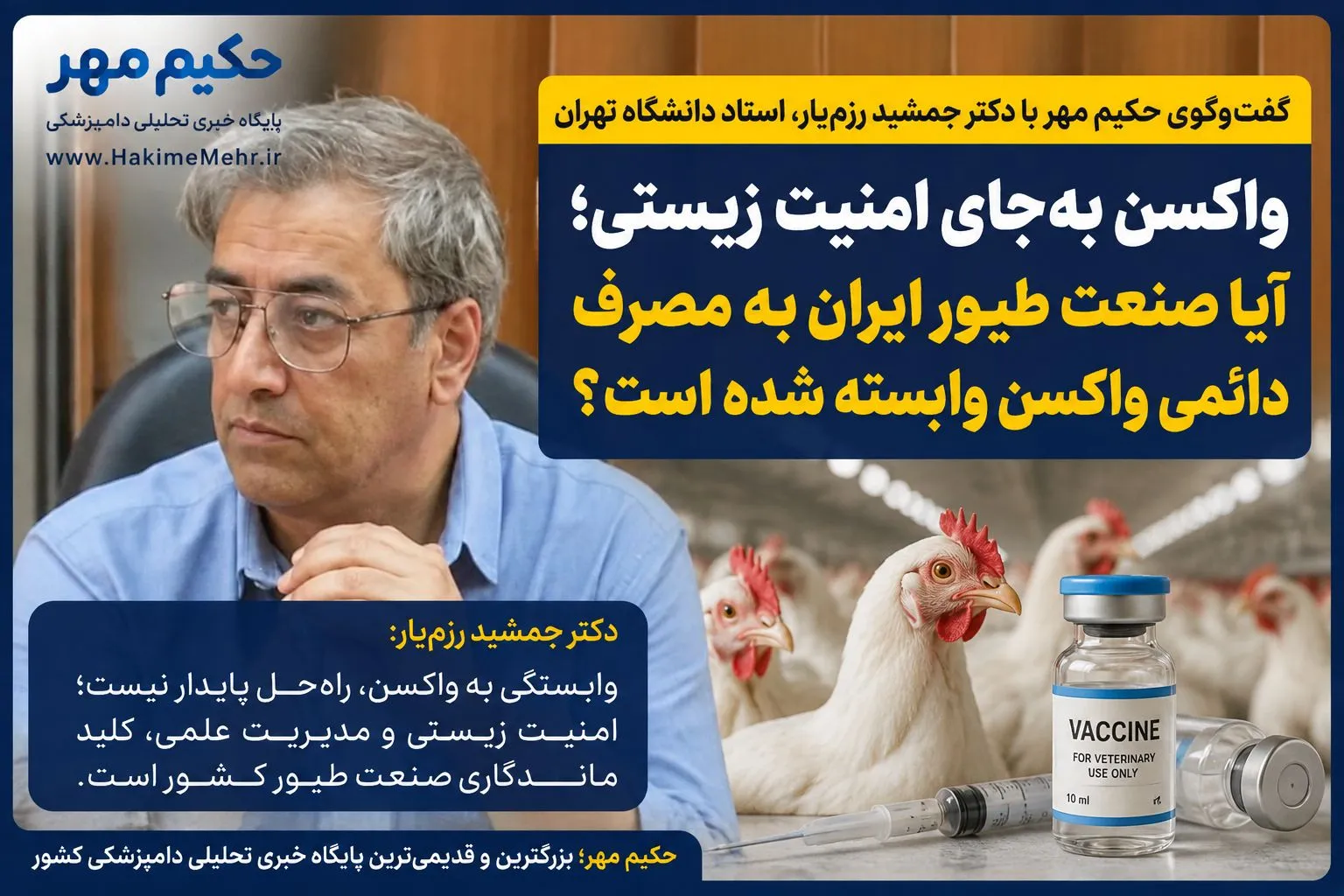
Official statistics indicate an annual market of approximately 10.5 to 11 billion doses of poultry vaccines. However, discrepancies between production, imports, distribution, and actual consumption, combined with extensive vaccination programs and weaknesses in biosecurity, have raised serious questions about Iran’s current poultry disease-control policies.
In this interview, Dr. Jamshid Razm-Yar emphasizes the need for statistical transparency, professional independence of veterinarians, and a shift away from a “vaccine-centered” approach toward prevention, surveillance, and eradication.
Hakim Mehr: According to published statistics, Iran’s poultry industry requires approximately 10.5 to 11 billion vaccine doses annually, including around 3.5 billion doses produced domestically and nearly 7.5 billion imported doses. Do these figures accurately represent the real market?
Dr. Jamshid Razm-Yar: Before making any judgment, it must first be clarified what is meant by a “dose.” Does each antigen contained in a multivalent vaccine count as one dose, or is each administration of a vaccine product considered one dose regardless of the number of antigens?
Production, importation, distribution, and actual consumption are four different concepts. Some vaccines may remain in storage, expire, be used in the following year, or be recorded as multivalent products. Therefore, simply stating that several billion doses have been produced or imported does not, by itself, indicate the actual level of consumption.
For a scientifically sound assessment, statistics should be published according to vaccine type, disease, manufacturer or importer, flock type, province, warehouse inventory, wastage, and final consumption.
Hakim Mehr: What is the approximate poultry population of Iran, and how does it compare with the volume of vaccines being used?
Dr. Razm-Yar: For an accurate estimate, the population should be considered in terms of “bird-cycles”, rather than simply the number of birds present on a particular day.
Annual broiler placement in Iran is estimated at approximately 1.5 to 1.6 billion birds. The active layer population is estimated at around 70 to 80 million birds, with approximately 50 to 60 million replacement pullets produced annually and around 10 to 13 million breeder birds. The grandparent and pure-line populations are considerably smaller, but their vaccination programs are more intensive and sensitive.
Based on these figures, if each antigen is counted separately, annual consumption could reach approximately 19 to 20 billion antigen doses. If combination vaccines are counted as a single commercial product, the estimated requirement would be approximately 11.5 to 15 billion commercial product doses.
Therefore, the figure of 11 billion can only be properly interpreted if the definition of the unit of measurement is clearly established.
Hakim Mehr: How intensive is the vaccination program commonly used in Iran?
Dr. Razm-Yar: In broiler chickens, a typical program may include three doses of live infectious bronchitis vaccine, three doses of live Newcastle disease vaccine, one dose of inactivated Newcastle disease vaccine, one dose of H9 vaccine, and two doses of Gumboro vaccine, equivalent to approximately 10 antigen doses.
If Newcastle–infectious bronchitis and Newcastle–H9 vaccines are administered as combination products, this program may be reduced to approximately 6 to 8 vaccine-product administrations.
In layers, approximately 28 to 32 antigen doses may be administered before the onset of production, while breeder birds may receive approximately 40 to 43 antigen doses. After the onset of production, Newcastle disease and infectious bronchitis vaccines are also repeated monthly in many flocks.
As a result, the cumulative exposure of an individual layer or breeder bird throughout its production cycle may exceed 50 to 60 antigen doses.
Hakim Mehr: Is this level of vaccine use comparable to that of major poultry-producing countries?
Dr. Razm-Yar: Compared with countries that have strong biosecurity, controlled stocking density, continuous surveillance, effective quarantine, and genuine disease elimination and eradication programs, Iran’s vaccination programs are more intensive.
In many low-risk areas of the United States and Europe, broilers receive approximately 4 to 6 antigens or 3 to 5 vaccine-product administrations. In Iran, this figure may reach 10 antigens and 6 to 8 administrations.
Therefore, Iran’s vaccine consumption is higher than the low-pressure global model. However, such a vaccination program is not necessarily unexpected in countries experiencing continuous circulation of Newcastle disease, infectious bronchitis, Gumboro disease, and avian influenza.
The fundamental question is whether this level of disease pressure is unavoidable or whether it is the result of chronic weaknesses in prevention and biosecurity.
Hakim Mehr: Do you believe that vaccines have replaced biosecurity in Iran?
Dr. Razm-Yar: In parts of the industry, this has indeed happened.
Vaccination should be one component of a disease-control program, not a substitute for biosecurity, quarantine, surveillance, rapid diagnosis, and outbreak elimination.
When control over the movement of people and vehicles, manure and carcass management, distance between farms, disinfection, live-bird markets, and hatchery operations is weak, vaccination becomes a permanent tool for tolerating disease rather than eliminating it.
Put simply, instead of addressing the underlying disease problem in the industry, we have increasingly relied on importing a “painkiller,” along with a limited amount of domestic production of the same “painkiller.”
This policy may reduce mortality, but it does not eliminate the infectious agent from the industry.
Hakim Mehr: What criticism do you have regarding the introduction of low-pathogenic H9 avian influenza?
Dr. Razm-Yar: Following the introduction of H9, instead of conducting a fully transparent investigation into its source, routes of spread, and methods of containment, the introduction and extent of the disease were not initially addressed with the necessary level of transparency.
Subsequently, widespread vaccination—even in broiler flocks—became the principal focus of disease control.
Since then, rather than implementing a program aimed at reducing viral circulation, gradually eliminating affected sources, and improving biosecurity, the extensive use of vaccines has become a permanent practice in the industry.
Vaccination may reduce mortality and production losses, but if the virus continues to circulate among flocks, the fundamental problem remains unresolved.
Hakim Mehr: Does avian influenza vaccination prevent infection?
Dr. Razm-Yar: Many avian influenza vaccines, particularly those that are not sterilizing vaccines, reduce the severity of clinical signs, mortality, and viral shedding; however, they do not necessarily prevent infection completely.
A vaccinated bird may become infected, develop milder clinical signs, and still transmit the virus within the flock.
This situation can make diagnosis more difficult and increase the possibility of silent viral circulation.
Therefore, vaccination without virological surveillance, regular sampling, and strong biosecurity may create a false perception of disease control.
Hakim Mehr: You have referred to the risk of genetic reassortment between low-pathogenic and highly pathogenic viruses. How does this risk arise?
Dr. Razm-Yar: Influenza A viruses have eight genomic segments. If a cell becomes infected with two different viruses, genetic reassortment can occur, resulting in new viruses containing combinations of genetic segments from both viruses.
Simply put, if two alternative choices are considered for several genetic segments, numerous potential combinations can emerge. For six binary segments, at least 64 theoretical combinations can be envisioned.
Of course, not all of these combinations will be stable, transmissible, or pathogenic. Nevertheless, the underlying scientific risk is real and significant.
Hakim Mehr: What virus was isolated in Qazvin in 2005?
Dr. Razm-Yar: In 2005, the Poultry Diseases Group at the University of Tehran, consisting of myself, Dr. Peyghambari, and Dr. Breen, isolated a virus from a poultry farm in Qazvin Province.
Based on the investigations conducted, five of its genes showed greater similarity to a low-pathogenic virus, while three genes showed greater similarity to a highly pathogenic virus.
This isolate was associated with high mortality, and the findings were reported to the Veterinary Organization.
For an independent scientific assessment, the genetic sequences, laboratory results, and official report concerning that isolate should be made available to the scientific community.
The purpose of raising this issue is to highlight the risk associated with the co-circulation of viruses and the necessity of continuous genetic surveillance.
Hakim Mehr: Following the emergence of highly pathogenic avian influenza and severe mortality among laying hens in Qazvin, Tehran, and Qom, vaccine imports were proposed as the primary solution. Was this approach sufficient?
Dr. Razm-Yar: In an emergency situation, vaccination can be part of the disease-control toolkit, but it should never be the only solution.
If the routes of virus introduction, movement of birds, informal markets, manure transportation, contaminated vehicles, and weaknesses in quarantine are not addressed, vaccination can only reduce the severity of the crisis.
A comprehensive program should include rapid detection, targeted culling, fair compensation, movement restrictions, active surveillance, genetic assessment of the virus, and regional biosecurity.
Otherwise, there is a possibility of continued silent viral circulation and permanent dependence of the industry on imported or domestically produced vaccines.
Hakim Mehr: Regarding Angara disease, do you also believe that vaccination replaced investigation into the root cause?
Dr. Razm-Yar: Following the sudden emergence of Angara disease in the eastern part of the country, the primary questions should have been: Through what route did the causative agent enter? Was it associated with the movement of chicks, feed or other inputs, vehicles, or cross-border trade? And why was the surveillance system unable to detect it earlier?
Vaccination may be necessary to reduce economic losses, but it cannot replace an epidemiological investigation into the root cause.
If the causes of introduction and spread are not identified, the cycle of disease introduction, dissemination, mortality, vaccine imports, and permanent vaccine consumption may be repeated again and again.
Hakim Mehr: What impact does this level of vaccination have on production costs?
Dr. Razm-Yar: The cost is not limited to the price of the vaccine.
The cold chain, transportation, labor, vaccine administration, flock stress, post-vaccination reactions, implementation errors, and potential interference between vaccination programs also generate costs.
Ultimately, these costs are transferred to the price of poultry meat and eggs.
Investment in biosecurity may initially appear expensive, but in the long term it can reduce vaccine and drug consumption, mortality, production losses, and market fluctuations.
Countries that have achieved better disease control have not necessarily used more vaccines; rather, they have established more effective prevention systems.
Hakim Mehr: Why is the capacity of the Poultry Diseases Group at the University of Tehran used less frequently?
Dr. Razm-Yar: The Poultry Diseases Group at the University of Tehran has a long history of education, diagnosis, and research. A significant proportion of the country’s poultry specialists and industry managers have been trained directly or indirectly by this university.
Despite this capacity, independent academic groups are sometimes not sufficiently involved in major national decisions.
Conversely, individuals who may have interests in vaccine production, importation, or distribution may be consulted.
Scientific decision-making should not be monopolized by the University of Tehran—or by any other institution. However, the composition of decision-making committees should be balanced, transparent, and free from undisclosed conflicts of interest.
Hakim Mehr: What should be done to break the cycle of disease, vaccination, and renewed dependency?
Dr. Razm-Yar: First, it must be accepted that vaccination is only one tool.
A national poultry disease-control program should be based on mandatory and measurable biosecurity, active surveillance and rapid data publication, epidemiological investigation, fair compensation, regional reassessment of vaccination programs, and complete transparency regarding vaccine production and imports.
The objective should not simply be to increase or decrease the number of vaccines used.
The objective should be to reduce circulation of infectious agents, eliminate unnecessary prescriptions, reduce the need for emergency vaccination, and gradually move from “disease tolerance” toward disease control and eradication.
Hakim Mehr: Following the appointment of Dr. Vahid Salehi as Acting Head of the Veterinary Organization of Iran, what do you expect from him?
Dr. Razm-Yar: I have always known Dr. Salehi as a scientific and capable individual with valuable management experience, as well as an energetic and responsible professional.
For this reason, I hope that during his tenure, special attention will be devoted to the country’s poultry industry.
The poultry industry is one of the most important sectors of Iran’s agriculture and plays a decisive role in food security, household livelihoods, employment, and the national economy.
Therefore, policymaking in this field must be based on scientific evidence, be forward-looking, and remain free from short-term and temporary decision-making.
In my opinion, the Poultry Office of the Veterinary Organization can use the capacity of universities, research centers, and specialized research institutes to develop short-, medium-, and long-term protocols and policies aimed at gradually reducing dependence on vaccination and ultimately moving away from vaccination in many controllable diseases.
Achieving such an objective requires programs with measurable indicators in education, research, and implementation, with managers and responsible institutions held accountable over time for the extent to which these objectives are achieved.
Another important point is the use of genuine specialists in the decision-making process.
It is expected that policymaking will avoid relying on individuals who lack relevant expertise, operate outside their field of specialization, or may have potential conflicts of interest, so that decisions are made solely on the basis of scientific evidence and national interests.
Finally, I wish Dr. Salehi success.
I hope the day comes when either managers have the opportunity to fully implement major strategic programs without being influenced by changes outside their areas of expertise, or the country’s long-term policies are developed in such a scientific, stable, and implementable manner that changes in management do not alter the strategic direction and objectives.
Official statistics indicate approximately 10.5 to 11 billion doses of poultry vaccines per year, while estimates based on commonly used vaccination programs suggest approximately 11.5 to 15 billion commercial product doses, or 19 to 20 billion antigen doses.
The discrepancy between these figures cannot be resolved without a clear definition of “dose” and the publication of actual consumption data.
The fundamental question is not whether vaccines are necessary. The question is whether vaccines are being used alongside biosecurity, quarantine, surveillance, and eradication—or instead of them.
Transparency regarding conflicts of interest, generic prescribing, actual consumption levels, and the role of vaccine manufacturers and distributors is also essential for maintaining the industry’s trust.